Flame Retardant Polycarbonate Sheet
B1 rated, ignition point 580 °C, self-extinguishing, no toxic smoke — for rail, public interiors and guarding.
Surface resistivity made to your specification — for electronics assembly, cleanrooms and equipment windows.
In an electronics plant, an ordinary polycarbonate window is a capacitor waiting to discharge into a board. ESD polycarbonate carries controlled surface resistivity so charge bleeds away instead of accumulating.
We produce anti-static sheet to the resistivity range you specify rather than offering one fixed grade, because the requirement is set by your process — a dissipative range for assembly benches is not the same as a conductive range for sensitive component handling.
| Property | Specification |
|---|---|
| Surface resistivity | Made to customer specification (dissipative or conductive range) |
| Treatment type | Permanent, through-thickness — not a topical anti-static spray |
| Thickness | 1 mm – 12 mm |
| Widths | 1220 / 1560 / 1820 / 2100 mm (other widths made to order) |
| Colours | Clear and tinted |
| Base properties | Full polycarbonate impact strength retained |
| Cleanroom suitability | Low outgassing grades available on request |
“ESD polycarbonate” covers a range, not one product, and the right grade is set by surface resistivity measured in ohms per square. Specifying the wrong band is the usual reason a panel either fails to protect components or, at the other extreme, cannot be used near live circuitry.
| Grade | Surface resistivity (Ω/sq) | Use it for |
|---|---|---|
| Conductive | Below 10&sup6 | Fast charge draining, ESD flooring-adjacent guards, grounded enclosures — not for panels near live circuitry |
| Static-dissipative | 10&sup6 to 10&sup9 | The usual choice for electronics assembly guards, viewing windows and equipment covers — drains charge in a controlled, non-sparking way |
| Anti-static (low charging) | 10&sup9 to 10¹¹ | Reducing dust attraction and nuisance static where full ESD protection is not required |
| Standard polycarbonate | Above 10¹² (insulative) | No ESD control — the baseline the ESD grades are compared against |
Our ESD sheet is made to the resistivity band you specify rather than sold as a single value, and the property is permanent and through-thickness — it does not wash off or wear away like a topical anti-static spray. Tell us the target range (or the standard your line is audited against, such as ANSI/ESD S20.20) and whether the part faces a cleanroom, and we specify the grade and confirm it on the material documents.
Sprayed and wiped anti-static treatments work until the panel is cleaned, then they stop — usually without anyone noticing, because the panel looks identical. Humidity changes have the same effect: topical treatments depend on ambient moisture to function at all, so they degrade in dry winter conditions precisely when static is worst.
Our ESD sheet is treated through the material, so performance does not depend on the cleaning schedule or the season.
Static-dissipative applications generally sit between 10⁶ and 10⁹ ohms per square; conductive requirements go lower. If your process has an ESD control standard, send it and we will produce to that range.
No. It is built into the sheet rather than applied to the surface, so cleaning and handling do not remove it.
Yes, on our CNC centres at the order-specific CNC tolerance confirmed after material, thickness, part geometry and drawing review, and it can be thermoformed. The anti-static property is unaffected by cutting because it runs through the thickness.
Request a quote MOQ & shipping
Electrical-property supplier check
This page is for ESD or anti-static polycarbonate, not every ESD plastic sheet. Define whether the application needs charge control for an equipment window, enclosure, clean area or fabricated guard, then name the required electrical property instead of using “anti-static” as a complete specification.
Ask how the sheet is identified after cutting and how the electrical result can be documented for the batch. Combine those questions with the drawing, quantity and destination in the RFQ; use the quality page to define the evidence format.
From the factory
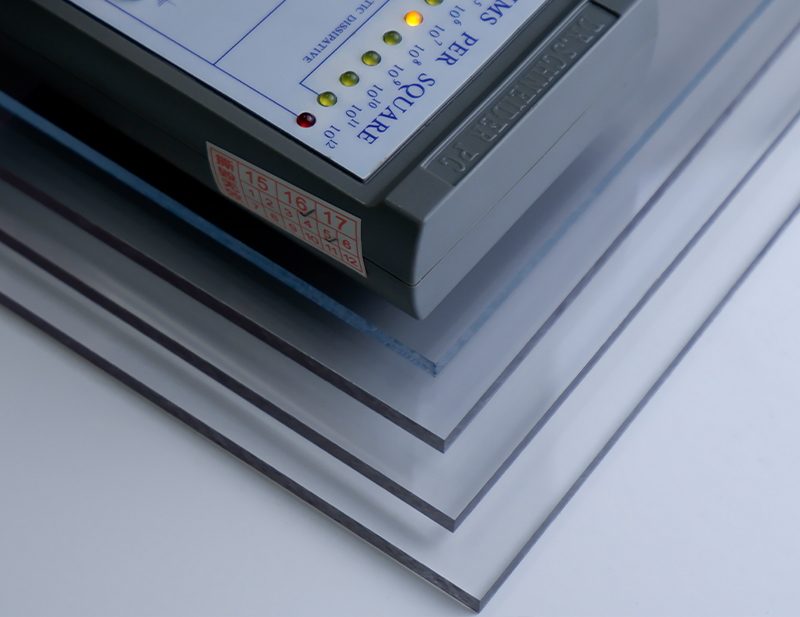
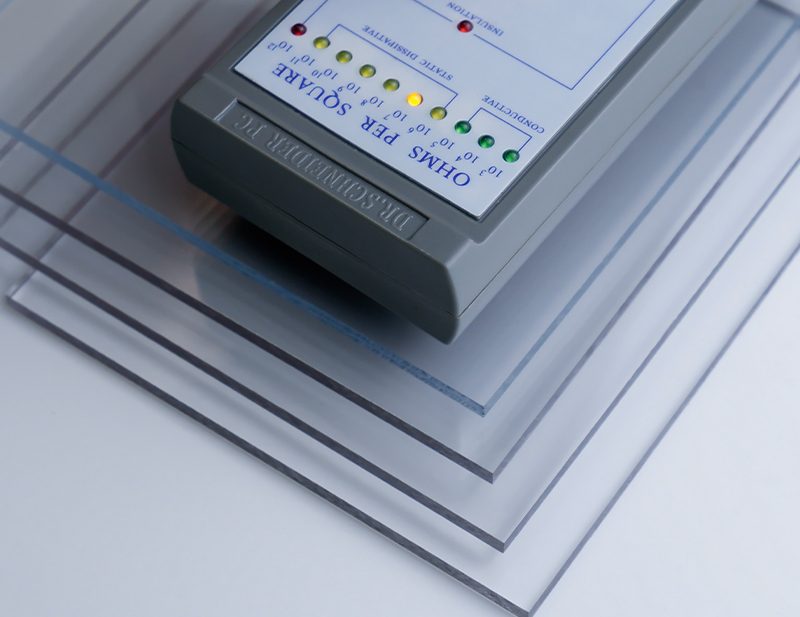
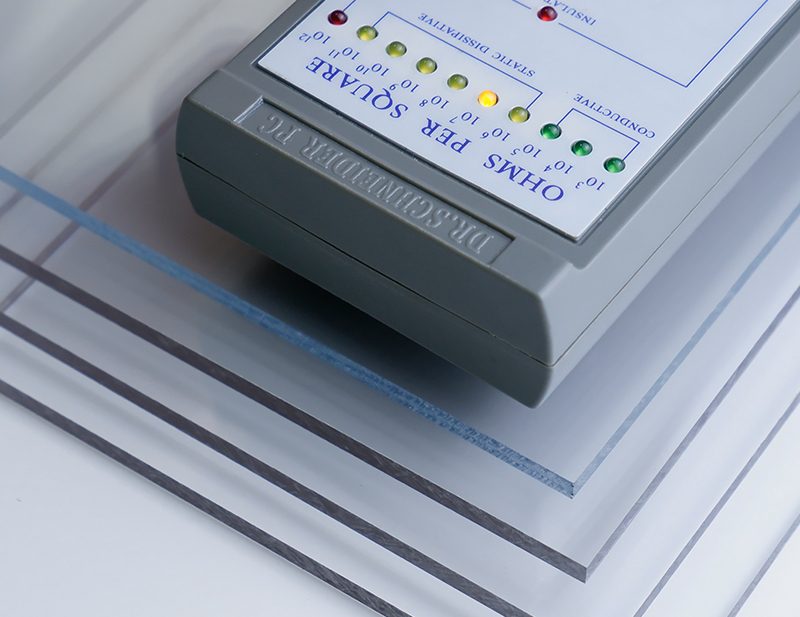
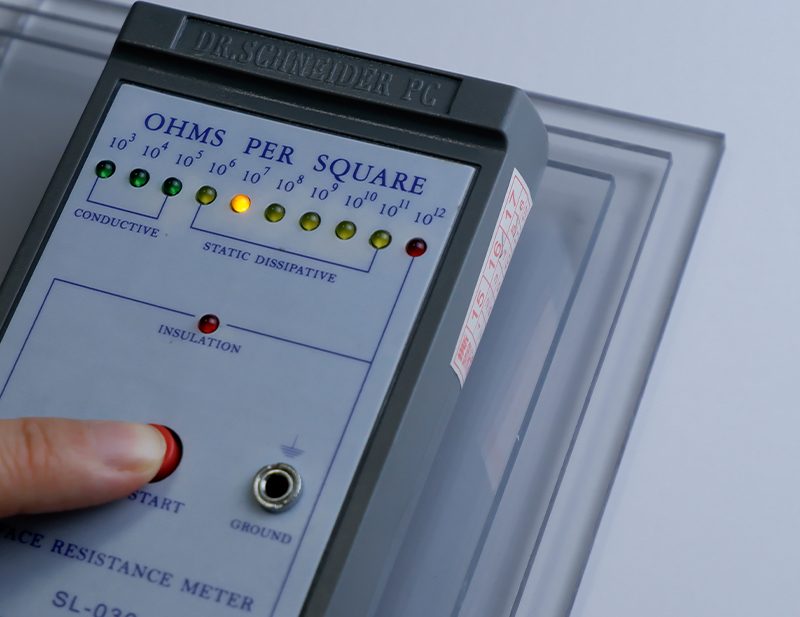
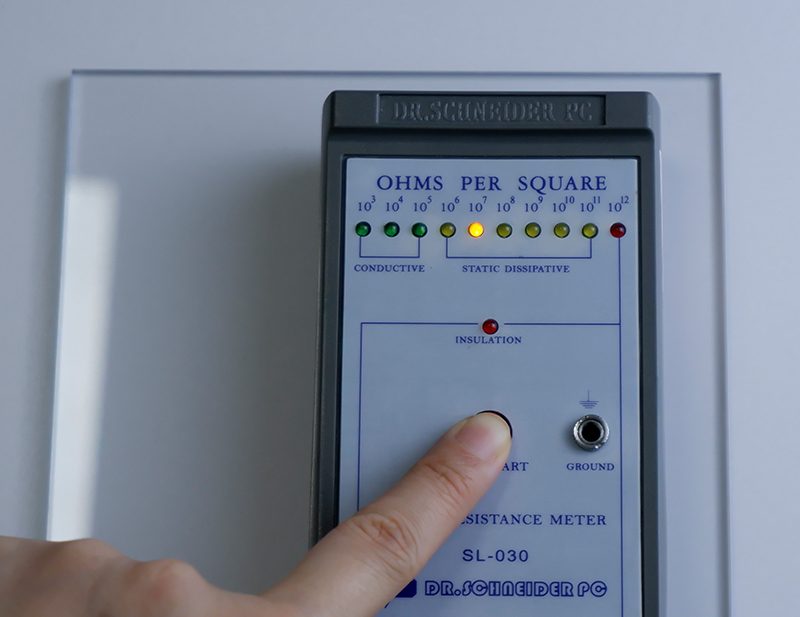
Images show the referenced product, process or application. Ask for a current production sample when colour, finish or fit must be approved.
Where to look next
B1 rated, ignition point 580 °C, self-extinguishing, no toxic smoke — for rail, public interiors and guarding.
Guards and viewing windows that stop a thrown tool — impact rated, fire rated, optionally anti-static.
Non-standard thickness, width, colour and construction — what we can make, and what we cannot.
Profiles, cut-outs, holes and engraving from your DXF, DWG or STEP files — 22 machines.
Start with a trial order
Thickness, size, colour, quantity — or just upload the drawing. We quote in USD on FOB, CIF or DDP terms, from 100 m² or 1 tonne. No full-container commitment required.