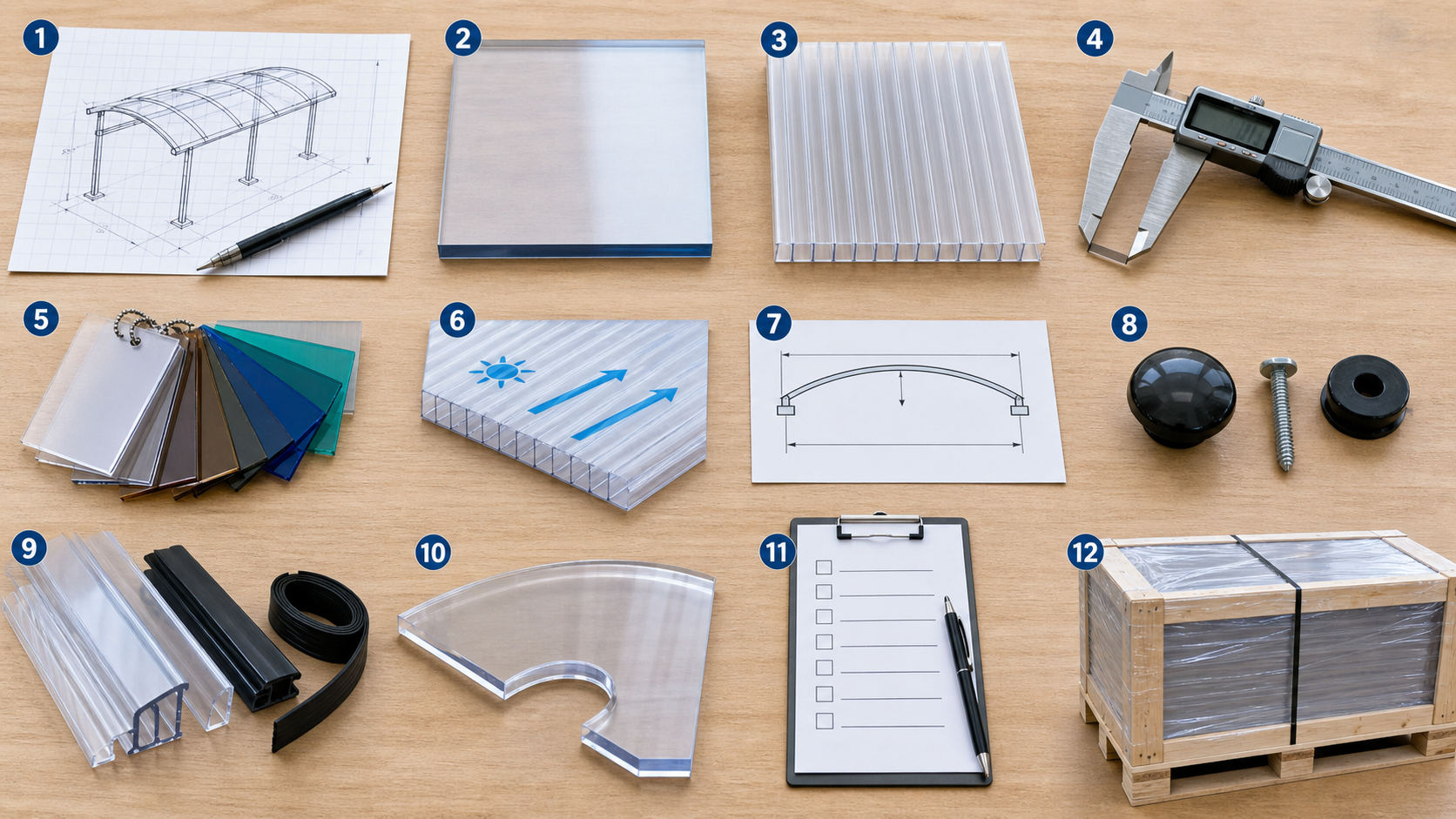
Short answer: Building with polycarbonate succeeds when twelve connected decisions are made before ordering: application, sheet structure, grade, thickness, color, UV exposure, span, thermal movement, joints, fabrication, acceptance and logistics. Treating the sheet as a drop-in substitute for glass or metal usually leaves critical details unresolved.
Start with the actual engineering decision
Freeze the performance brief before asking for price. A cheaper sheet that forces a new frame, fails a fire submittal or arrives without the correct UV side and profiles is not a cheaper project.
Plastura is the export brand of Jiangsu Xinjincheng New Materials Co., Ltd. Our Jiangsu team extrudes solid and multiwall polycarbonate and reviews fabrication drawings before production. That firsthand workflow helps identify practical questions, but it does not replace project engineering or independent certification.
| Situation | Best-fit approach | What to verify |
|---|---|---|
| Performance brief | Load, light, insulation, impact and life | Owner-approved priorities |
| Material definition | Solid/multiwall/profile, grade and color | Current technical data |
| System design | Span, edges, joints, movement and drainage | Coordinated drawings |
| Supply plan | Finished size, tolerance, packing and sequence | Inspection and traceability |
How to compare supplier evidence
For building with polycarbonate, place competing documents in one comparison sheet. Record full grade, thickness, color, surface or UV construction, specimen conditioning, test method and units. Generic polymer values are useful for orientation but do not prove a commercial sheet. Values from different standards or specimen geometries should be marked non-equivalent.
Separate resin data, finished-sheet data, independent reports, declarations and warranties: each answers a different question. Check issue date, tested thickness, production location and whether the quoted color or coating is covered. A responsible professional should approve evidence for regulated or safety-related work.
Questions to close during drawing review
Before approving building with polycarbonate, turn the selection table into drawing notes and submittal actions. The following questions should have named owners rather than being left for the installer or machine operator to decide:
- For performance brief, record owner-approved priorities and identify who approves the result.
- For material definition, record current technical data and identify who approves the result.
- For system design, record coordinated drawings and identify who approves the result.
- For supply plan, record inspection and traceability and identify who approves the result.
Also state the consequence if a requirement is missed. Appearance rework, leakage, loss of visibility, part cracking and safety failure require different inspection depth and escalation. This risk ranking determines which feature needs a sample, calculation, supplier declaration or independent test.
A controlled selection and production workflow
- Define application and consequence of failure
- Choose sheet structure and documented grade
- Calculate thickness and support from actual loads
- Set color, optical and UV requirements
- Detail thermal expansion and edge engagement
- Select profiles, gaskets, fasteners and compatible sealants
- Review cutting, drilling, bending and coating limits
- Create measurable appearance and dimensional acceptance rules
- Prototype the highest-risk feature or bay
- Freeze drawing and material revisions
- Plan protective packing, unloading and storage
- Inspect installation and retain submittal records
For a useful first article, reproduce the quoted resin grade, thickness, color, coating or UV construction, tooling, supports and downstream exposure. Record drawing revision, lot identity, inspection lighting and acceptance method. A visually acceptable sample does not automatically prove structural, chemical, weathering or regulatory performance.
Make the first article reproducible
A first article for building with polycarbonate is useful only when its material, geometry, processing and exposure match production. Save measurements, viewing conditions and any functional test alongside the approved drawing. Later lots should be checked against that evidence, not memory.
Protect finish and geometry through packing: isolate faces, support long spans, avoid tight straps over unsupported sheet and mark handling orientation. Traceability should continue until the customer completes incoming inspection.
What our factory needs before quotation
- Application, installation location and expected service environment.
- 2D drawing or finished length, width, thickness and tolerances.
- Solid, multiwall, profiled or acrylic construction and required grade.
- Clear, tint, matte or diffusing appearance with an approved reference where needed.
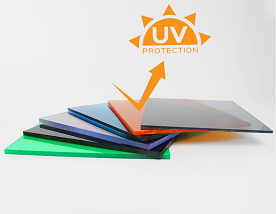
- UV exposure, coated side, fabrication, holes, bends and edge requirements.
- Order quantity, packing restrictions, destination and required documentation.
The factory can review manufacturability, sheet construction, cutting and packing. The responsible project professionals retain approval for structure, fire, safety, security, waterproofing and code compliance.
Failure modes to catch before release
- Ordering by thickness and color only
- Changing grade after prototype approval without revalidation
- Using sharp inside corners or tight holes that concentrate stress
- Letting packaging film remain outdoors beyond removal guidance
Investigate failures as interactions among material, residual stress, support, chemical exposure, temperature and time. Do not change several variables at once: preserve the affected sample, compare it with the approved reference and document the corrective trial.
Primary references
- Plaskolite TUFFAK polycarbonate fabrication guide. Confirm the current edition and applicability to the quoted grade or project.
- Plaskolite POLYGAL multiwall fabrication and installation guide. Confirm the current edition and applicability to the quoted grade or project.
Frequently asked questions
What information should be sent for a quote?
Send drawings, application, sheet form, thickness, color, UV exposure, quantity, tolerance, destination and required evidence.
Can polycarbonate replace glass directly?
Sometimes, but thermal movement, stiffness, scratch behavior, fire requirements and framing details differ.
Should panels be ordered cut to size?
Cut-to-size supply can reduce site work when dimensions, tolerances, packing and installation sequence are controlled.
Send a specification for review
Review the related Plastura product or application page, or send the drawing and service conditions for a written quotation. State any required test method and acceptance threshold instead of relying on a generic material claim.
Editorial boundary: This guide supports material selection and supplier communication. It is not a project warranty, structural calculation, safety certification or legal interpretation.
Buying rather than researching? We manufacture in Jiangsu, China and ship worldwide – see glazing and facade panels, or send your specification for a quote in one working day.