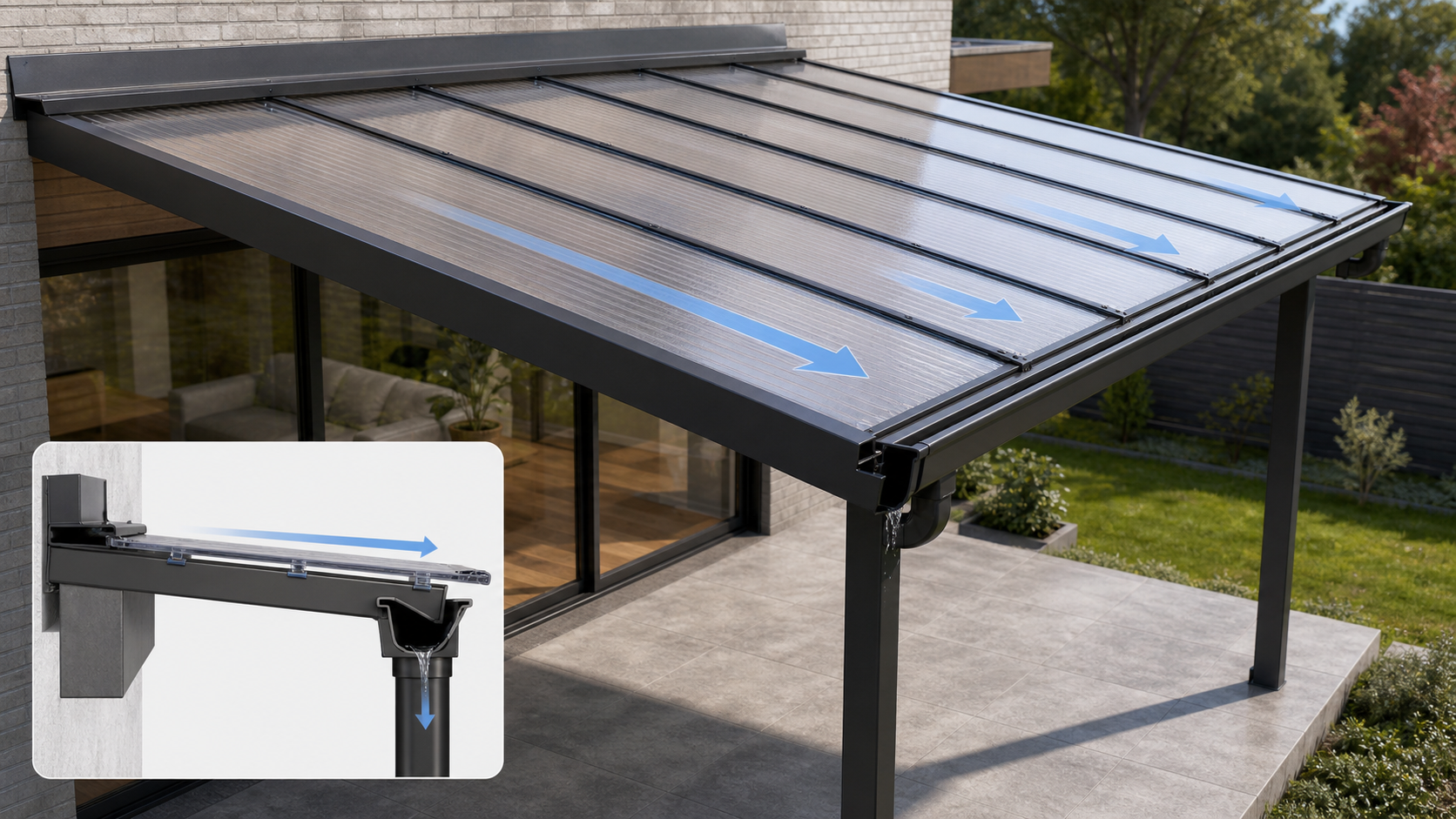
Short answer: Polycarbonate panels can be used on some low-slope roofs, but a truly flat, ponding roof is not the same thing. The selected panel system needs positive drainage, sufficient slope, load capacity, watertight joints, controlled deflection and details that prevent water from backing up at flashings.
Start with the actual engineering decision
Use the minimum slope and span limits from the exact system manufacturer, then have the project designer check rain, snow, wind, deflection, gutter capacity and local code. Increasing sealant is not a substitute for drainage.
Plastura is the export brand of Jiangsu Xinjincheng New Materials Co., Ltd. Our Jiangsu team extrudes solid and multiwall polycarbonate and reviews fabrication drawings before production. That firsthand workflow helps identify practical questions, but it does not replace project engineering or independent certification.
| Situation | Best-fit approach | What to verify |
|---|---|---|
| Positive low slope | Water moves continuously to outlet | Confirm manufacturer minimum |
| Zero slope/ponding | Standing water and debris risk | Usually requires a different roof concept |
| Long panel run | More thermal movement and runoff | Check joint and gutter capacity |
| Deflecting panel | Local low spot forms under load | Structural span review required |
What counts as usable evidence?
Usable evidence for polycarbonate flat roof panels connects a claim to an identifiable grade and defined method. Record document owner, revision, specimen, conditioning and result. Treat phrases such as high impact, UV resistant or long lasting as search terms for supporting data, not as acceptance criteria.
Keep compliance, engineering and commercial documents separate. The project team should decide which standard applies; the supplier should show what was tested; the purchase order should state the approved grade and permitted substitutions.
Questions to close during drawing review
Before approving polycarbonate flat roof panels, turn the selection table into drawing notes and submittal actions. The following questions should have named owners rather than being left for the installer or machine operator to decide:
- For positive low slope, record confirm manufacturer minimum and identify who approves the result.
- For zero slope/ponding, record usually requires a different roof concept and identify who approves the result.
- For long panel run, record check joint and gutter capacity and identify who approves the result.
- For deflecting panel, record structural span review required and identify who approves the result.
Also state the consequence if a requirement is missed. Appearance rework, leakage, loss of visibility, part cracking and safety failure require different inspection depth and escalation. This risk ranking determines which feature needs a sample, calculation, supplier declaration or independent test.
A controlled selection and production workflow
- Survey actual high and low points of the supporting structure
- Choose a panel system approved for the intended slope
- Calculate load, deflection, runoff and outlet capacity
- Detail head flashing, side joints, eaves and overflow paths
- Water-test completed work and inspect again under service load
For a useful first article, reproduce the quoted resin grade, thickness, color, coating or UV construction, tooling, supports and downstream exposure. Record drawing revision, lot identity, inspection lighting and acceptance method. A visually acceptable sample does not automatically prove structural, chemical, weathering or regulatory performance.
From approved sample to repeat production
Keep the approved polycarbonate flat roof panels sample with its drawing revision and inspection record. Production control should preserve sheet identity, orientation, tooling, setup and protective handling. When a result changes, compare one variable at a time—lot, tool wear, fixture, temperature, cleaner or packing.
Separate transparent faces with compatible protection, restrain parts without point loading and identify coated or UV faces. Photograph the packed condition so appearance changes after international shipment can be investigated.
What our factory needs before quotation
- Application, installation location and expected service environment.
- 2D drawing or finished length, width, thickness and tolerances.
- Solid, multiwall, profiled or acrylic construction and required grade.
- Clear, tint, matte or diffusing appearance with an approved reference where needed.
- UV exposure, coated side, fabrication, holes, bends and edge requirements.
- Order quantity, packing restrictions, destination and required documentation.
The factory can review manufacturability, sheet construction, cutting and packing. The responsible project professionals retain approval for structure, fire, safety, security, waterproofing and code compliance.
Failure modes to catch before release
- Calling a roof flat when the system needs measurable fall
- Allowing panel deflection to create a pond between supports
- Relying on field-applied sealant at every joint
- Blocking gutter flow with end profiles or debris screens
Investigate failures as interactions among material, residual stress, support, chemical exposure, temperature and time. Do not change several variables at once: preserve the affected sample, compare it with the approved reference and document the corrective trial.
Primary references
- Palram roofing installation resources. Confirm the current edition and applicability to the quoted grade or project.
- Palram SUNGLAZE standing-seam roof system resources. Confirm the current edition and applicability to the quoted grade or project.
Frequently asked questions
Can polycarbonate be installed horizontally?
Do not assume so. Roofing systems normally require positive slope; follow the exact system instructions.
Will more screws stop leaks?
Extra or overtightened fasteners can damage the panel. Correct system layout, slope, washers and joints matter.
Who sets the minimum slope?
The panel-system manufacturer provides product limits; the project designer also checks climate, structure and code.
Send a specification for review
Review the related Plastura product or application page, or send the drawing and service conditions for a written quotation. State any required test method and acceptance threshold instead of relying on a generic material claim.
Editorial boundary: This guide supports material selection and supplier communication. It is not a project warranty, structural calculation, safety certification or legal interpretation.
Buying rather than researching? We manufacture in Jiangsu, China and ship worldwide – see polycarbonate roofing sheet, or send your specification for a quote in one working day.