Short answer: Glue polycarbonate only after matching the adhesive to the exact grade, joint geometry, load and service environment. Polycarbonate is susceptible to environmental stress cracking from some solvents and adhesive ingredients. A small unstressed compatibility coupon is useful, but a production-representative stressed joint is the real approval test.
Start with the actual engineering decision
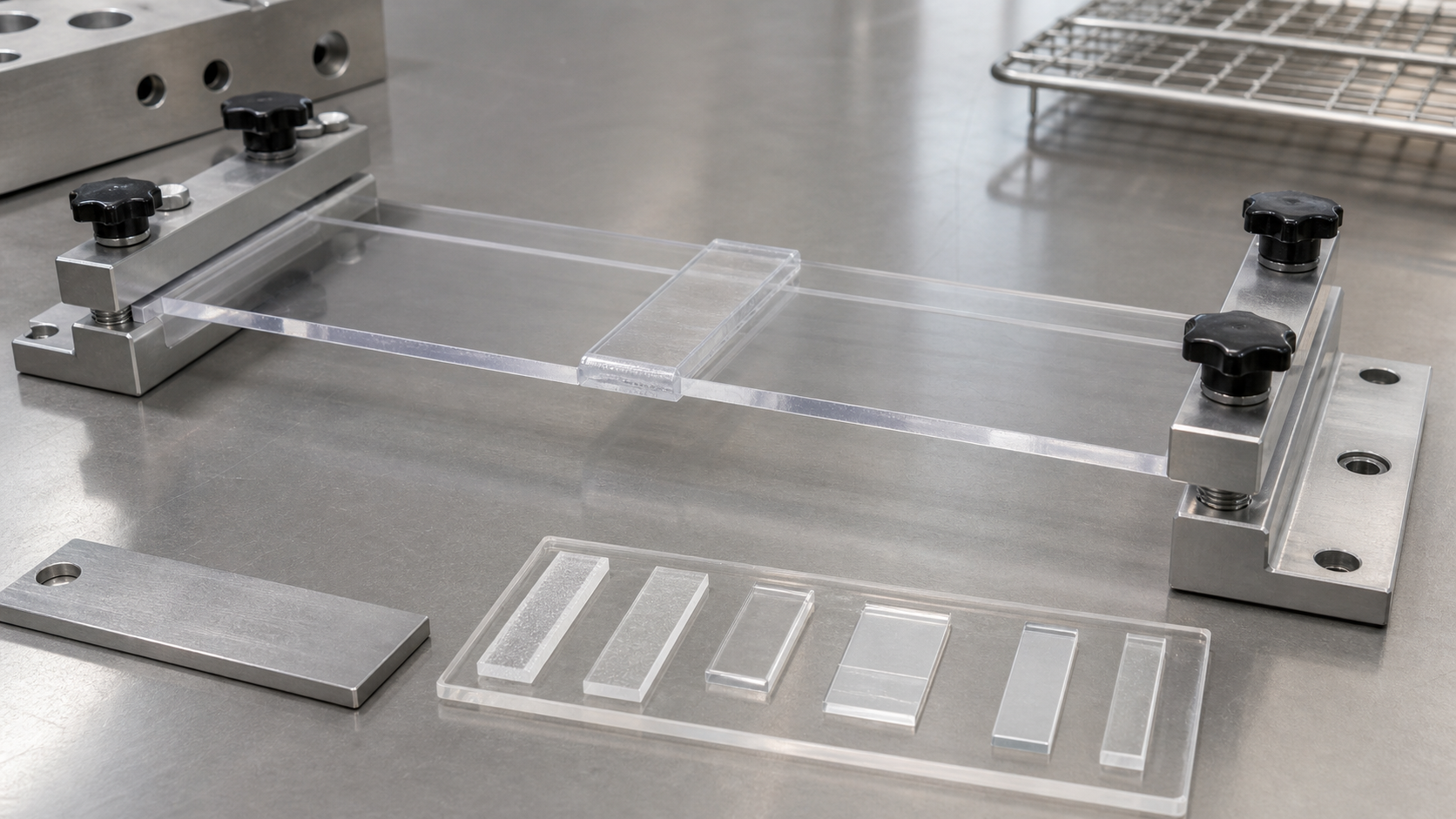
Mechanical fastening is often preferable when the joint needs serviceability or uncertain chemical exposure. Adhesive bonding can suit sealed or cosmetic assemblies when surface preparation, gap, cure and long-term compatibility are controlled.
Plastura is the export brand of Jiangsu Xinjincheng New Materials Co., Ltd. Our Jiangsu team extrudes solid and multiwall polycarbonate and reviews fabrication drawings before production. That firsthand workflow helps identify practical questions, but it does not replace project engineering or independent certification.
| Situation | Best-fit approach | What to verify |
|---|---|---|
| Close rigid joint | Supplier-approved structural adhesive | Gap, cure, stress and optical appearance |
| Sealed enclosure | Compatible adhesive or sealant | Fluid, pressure and cleaning exposure |
| Mixed materials | Flexible or mechanical joint | Differential thermal movement |
| Serviceable cover | Fasteners with load spreaders | Hole clearance and tightening control |
Read the test report before comparing numbers
A high value in a brochure is not enough to specify how to glue polycarbonate. Identify what was tested, specimen thickness, support, conditioning, temperature, loading direction and acceptance rule. Ask whether the result is typical, minimum, certified or limited to one production sample. If the method is missing, do not treat the number as directly comparable.
Trace every important claim to the quoted grade and current document revision. A material certificate confirms a supplied lot; a test report records a defined test; a warranty describes contractual coverage. None of these alone establishes installed-system performance.
Questions to close during drawing review
Before approving how to glue polycarbonate, turn the selection table into drawing notes and submittal actions. The following questions should have named owners rather than being left for the installer or machine operator to decide:
- For close rigid joint, record gap, cure, stress and optical appearance and identify who approves the result.
- For sealed enclosure, record fluid, pressure and cleaning exposure and identify who approves the result.
- For mixed materials, record differential thermal movement and identify who approves the result.
- For serviceable cover, record hole clearance and tightening control and identify who approves the result.
Also state the consequence if a requirement is missed. Appearance rework, leakage, loss of visibility, part cracking and safety failure require different inspection depth and escalation. This risk ranking determines which feature needs a sample, calculation, supplier declaration or independent test.
A controlled selection and production workflow
- Identify exact polycarbonate grade, coating, masking and prior fabrication
- Define whether the joint carries load, seals fluid or is cosmetic
- Ask the adhesive supplier for written compatibility and processing guidance
- Prepare and cure samples using the real gap, surface and environment
- Load, clean and age a representative joint before production release
For a useful first article, reproduce the quoted resin grade, thickness, color, coating or UV construction, tooling, supports and downstream exposure. Record drawing revision, lot identity, inspection lighting and acceptance method. A visually acceptable sample does not automatically prove structural, chemical, weathering or regulatory performance.
Make the first article reproducible
A first article for how to glue polycarbonate is useful only when its material, geometry, processing and exposure match production. Save measurements, viewing conditions and any functional test alongside the approved drawing. Later lots should be checked against that evidence, not memory.
Protect finish and geometry through packing: isolate faces, support long spans, avoid tight straps over unsupported sheet and mark handling orientation. Traceability should continue until the customer completes incoming inspection.
What our factory needs before quotation
- Application, installation location and expected service environment.
- 2D drawing or finished length, width, thickness and tolerances.
- Solid, multiwall, profiled or acrylic construction and required grade.
- Clear, tint, matte or diffusing appearance with an approved reference where needed.
- UV exposure, coated side, fabrication, holes, bends and edge requirements.
- Order quantity, packing restrictions, destination and required documentation.
The factory can review manufacturability, sheet construction, cutting and packing. The responsible project professionals retain approval for structure, fire, safety, security, waterproofing and code compliance.
Failure modes to catch before release
- Using an aggressive solvent because it appears to make a fast bond
- Bonding a hard-coated face without confirming adhesion
- Clamping so hard that adhesive is starved from the joint
- Evaluating appearance but not creep, temperature or cleaning exposure
Investigate failures as interactions among material, residual stress, support, chemical exposure, temperature and time. Do not change several variables at once: preserve the affected sample, compare it with the approved reference and document the corrective trial.
Primary references
- Covestro Makrolon chemical-resistance guidance. Confirm the current edition and applicability to the quoted grade or project.
- Plaskolite TUFFAK polycarbonate fabrication guide. Confirm the current edition and applicability to the quoted grade or project.
Frequently asked questions
Can super glue be used on polycarbonate?
Do not assume it is compatible. Some cyanoacrylates or their vapors can haze or stress-crack polycarbonate; obtain grade-specific supplier guidance and test.
Should polycarbonate be flame polished before bonding?
Avoid adding uncontrolled heat and stress. Use the adhesive supplier's required surface preparation.
Is silicone safe for polycarbonate?
Some neutral-cure products may be suitable, but formulations vary. Obtain written compatibility for the exact sealant and test the assembly.
Send a specification for review
Review the related Plastura product or application page, or send the drawing and service conditions for a written quotation. State any required test method and acceptance threshold instead of relying on a generic material claim.
Editorial boundary: This guide supports material selection and supplier communication. It is not a project warranty, structural calculation, safety certification or legal interpretation.
Buying rather than researching? We manufacture in Jiangsu, China and ship worldwide – see bending, forming and assembly service, or send your specification for a quote in one working day.