How to Cut Polycarbonate Sheet Without Cracking: Blade, Speed and Support Guide
Short answer: Cut polycarbonate with a sharp carbide-tipped blade, stable support and controlled chip removal. Leave the masking on during fabrication, prevent vibration, and test the exact sheet thickness before committing the finished part. A clean cut depends more on support, blade condition and heat control than on one universal speed setting.
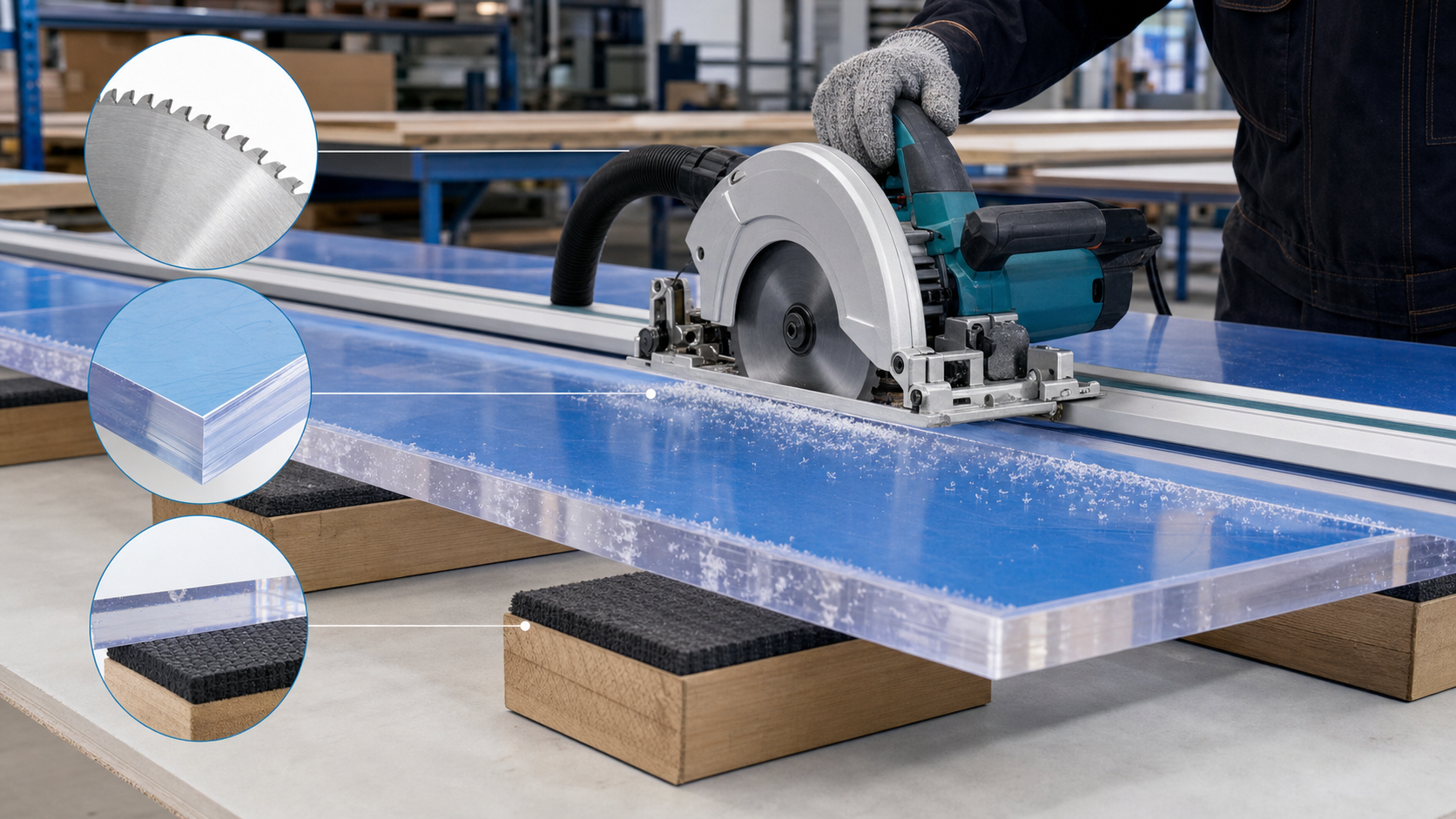
Start with the actual engineering decision
The tool should follow sheet form, thickness, cut length and required edge quality. Thin sheet may suit a fine-tooth jigsaw or scoring method only when the grade permits it; long straight cuts usually favor a guided circular or table saw; production contours favor CNC routing.
Plastura is the export brand of Jiangsu Xinjincheng New Materials Co., Ltd. Our Jiangsu team extrudes solid and multiwall polycarbonate and reviews fabrication drawings before production. That firsthand workflow helps identify practical questions, but it does not replace project engineering or independent certification.
| Situation | Best-fit approach | What to verify |
|---|---|---|
| Long straight cut | Fine-tooth carbide circular or table saw | Full support, guide alignment and chip evacuation |
| Curved profile | Jigsaw without aggressive pendulum action | Blade heat, vibration and corner radius |
| Precision production part | CNC router | Tool geometry, fixturing and first-article inspection |
| Multiwall panel | Circular saw plus clean compressed air | Remove chips from cells and seal cut ends |
How to compare supplier evidence
For how to cut polycarbonate sheet, place competing documents in one comparison sheet. Record full grade, thickness, color, surface or UV construction, specimen conditioning, test method and units. Generic polymer values are useful for orientation but do not prove a commercial sheet. Values from different standards or specimen geometries should be marked non-equivalent.
Separate resin data, finished-sheet data, independent reports, declarations and warranties: each answers a different question. Check issue date, tested thickness, production location and whether the quoted color or coating is covered. A responsible professional should approve evidence for regulated or safety-related work.
Questions to close during drawing review
Before approving how to cut polycarbonate sheet, turn the selection table into drawing notes and submittal actions. The following questions should have named owners rather than being left for the installer or machine operator to decide:
- For long straight cut, record full support, guide alignment and chip evacuation and identify who approves the result.
- For curved profile, record blade heat, vibration and corner radius and identify who approves the result.
- For precision production part, record tool geometry, fixturing and first-article inspection and identify who approves the result.
- For multiwall panel, record remove chips from cells and seal cut ends and identify who approves the result.
Also state the consequence if a requirement is missed. Appearance rework, leakage, loss of visibility, part cracking and safety failure require different inspection depth and escalation. This risk ranking determines which feature needs a sample, calculation, supplier declaration or independent test.
A controlled selection and production workflow
- Confirm solid, multiwall or coated grade and keep the protective masking in place
- Mark the cut on the masking and support both sides close to the cut line
- Use a sharp plastics-appropriate blade and make a trial cut on an offcut
- Feed steadily so chips form and clear instead of melting back onto the edge
- Deburr without gouging, clean with compatible methods and inspect for edge cracks
For a useful first article, reproduce the quoted resin grade, thickness, color, coating or UV construction, tooling, supports and downstream exposure. Record drawing revision, lot identity, inspection lighting and acceptance method. A visually acceptable sample does not automatically prove structural, chemical, weathering or regulatory performance.
From approved sample to repeat production
Keep the approved how to cut polycarbonate sheet sample with its drawing revision and inspection record. Production control should preserve sheet identity, orientation, tooling, setup and protective handling. When a result changes, compare one variable at a time—lot, tool wear, fixture, temperature, cleaner or packing.
Separate transparent faces with compatible protection, restrain parts without point loading and identify coated or UV faces. Photograph the packed condition so appearance changes after international shipment can be investigated.
What our factory needs before quotation
- Application, installation location and expected service environment.
- 2D drawing or finished length, width, thickness and tolerances.
- Solid, multiwall, profiled or acrylic construction and required grade.
- Clear, tint, matte or diffusing appearance with an approved reference where needed.
- UV exposure, coated side, fabrication, holes, bends and edge requirements.
- Order quantity, packing restrictions, destination and required documentation.
The factory can review manufacturability, sheet construction, cutting and packing. The responsible project professionals retain approval for structure, fire, safety, security, waterproofing and code compliance.
Failure modes to catch before release
- Using a dull blade that rubs and melts the kerf
- Letting a large offcut hang and fracture the last part of the cut
- Contaminating the sheet with cutting oil or an incompatible cleaner
- Removing masking early and scratching the optical face
Investigate failures as interactions among material, residual stress, support, chemical exposure, temperature and time. Do not change several variables at once: preserve the affected sample, compare it with the approved reference and document the corrective trial.
Primary references
- Plaskolite TUFFAK polycarbonate fabrication guide. Confirm the current edition and applicability to the quoted grade or project.
- Plaskolite POLYGAL multiwall fabrication and installation guide. Confirm the current edition and applicability to the quoted grade or project.
Frequently asked questions
Can polycarbonate be cut with a circular saw?
Yes. Use a sharp fine-tooth carbide blade, a straight guide and full support; confirm the blade and feed on an offcut first.
Why does the edge melt?
Heat is building faster than chips can leave. Check blade sharpness, tooth form, feed, support and whether chips are being recut.
Can a laser cut polycarbonate?
Some laser processes can discolor, char or leave stressed edges. Obtain process-specific evidence before choosing laser cutting for an optical or load-bearing part.
Send a specification for review
Review the related Plastura product or application page, or send the drawing and service conditions for a written quotation. State any required test method and acceptance threshold instead of relying on a generic material claim.
Editorial boundary: This guide supports material selection and supplier communication. It is not a project warranty, structural calculation, safety certification or legal interpretation.
Buying rather than researching? We manufacture in Jiangsu, China and ship worldwide – see factory cut-to-size service, or send your specification for a quote in one working day.