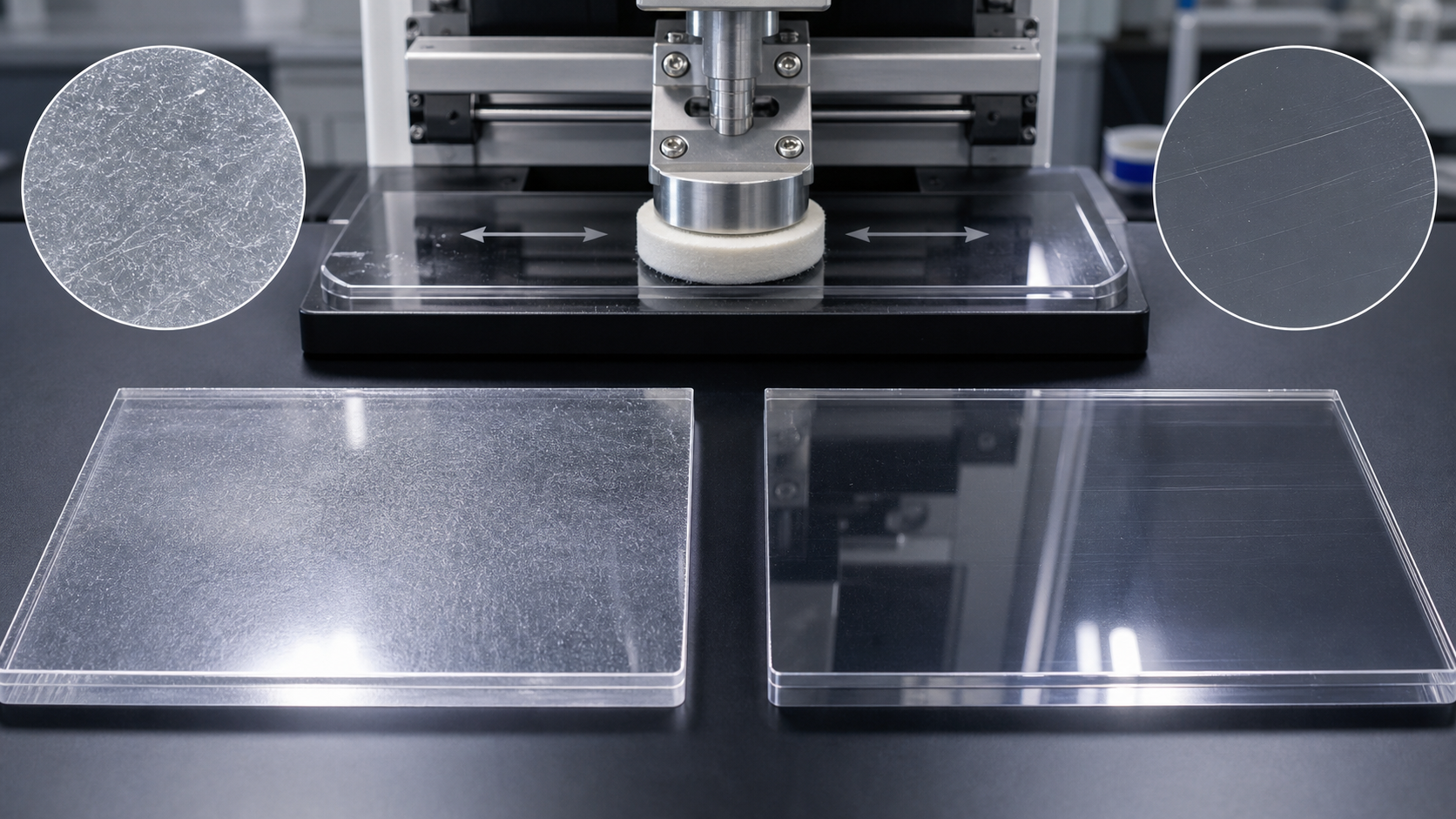
Short answer: Abrasion-resistant polycarbonate is sheet with a hard surface coating intended to improve resistance to cleaning wear, fine scratching, chemicals or weathering. It is not scratch-proof. Coating chemistry, coated side, forming restrictions, edge treatment and the relevant abrasion test must match the application.
Start with the actual engineering decision
Choose hard-coated sheet when repeated cleaning, wipers, dust or public contact would make standard polycarbonate haze too quickly. Standard sheet may remain the better choice when deep forming, easy bonding or low-contact indoor use matters more.
Plastura is the export brand of Jiangsu Xinjincheng New Materials Co., Ltd. Our Jiangsu team extrudes solid and multiwall polycarbonate and reviews fabrication drawings before production. That firsthand workflow helps identify practical questions, but it does not replace project engineering or independent certification.
| Situation | Best-fit approach | What to verify |
|---|---|---|
| Machine window | Frequent wiping and coolant mist | Abrasion plus chemical compatibility |
| Public barrier | Touch and repeated cleaning | Both-side coating and edge protection |
| Vehicle glazing | Wiper and weather exposure | Qualified glazing grade and regulations |
| Formed cover | Bending or thermoforming required | Confirm coating process limits first |
What counts as usable evidence?
Usable evidence for abrasion resistant polycarbonate connects a claim to an identifiable grade and defined method. Record document owner, revision, specimen, conditioning and result. Treat phrases such as high impact, UV resistant or long lasting as search terms for supporting data, not as acceptance criteria.
Keep compliance, engineering and commercial documents separate. The project team should decide which standard applies; the supplier should show what was tested; the purchase order should state the approved grade and permitted substitutions.
Questions to close during drawing review
Before approving abrasion resistant polycarbonate, turn the selection table into drawing notes and submittal actions. The following questions should have named owners rather than being left for the installer or machine operator to decide:
- For machine window, record abrasion plus chemical compatibility and identify who approves the result.
- For public barrier, record both-side coating and edge protection and identify who approves the result.
- For vehicle glazing, record qualified glazing grade and regulations and identify who approves the result.
- For formed cover, record confirm coating process limits first and identify who approves the result.
Also state the consequence if a requirement is missed. Appearance rework, leakage, loss of visibility, part cracking and safety failure require different inspection depth and escalation. This risk ranking determines which feature needs a sample, calculation, supplier declaration or independent test.
A controlled selection and production workflow
- List cleaning frequency, particles, chemicals and expected viewing quality
- Specify one-side or two-side coating and identify the exposed face
- Request the relevant abrasion, adhesion and chemical test evidence
- Fabricate coated coupons using planned cutting, drilling and forming
- Approve initial clarity and aged appearance under defined lighting
For a useful first article, reproduce the quoted resin grade, thickness, color, coating or UV construction, tooling, supports and downstream exposure. Record drawing revision, lot identity, inspection lighting and acceptance method. A visually acceptable sample does not automatically prove structural, chemical, weathering or regulatory performance.
From approved sample to repeat production
Keep the approved abrasion resistant polycarbonate sample with its drawing revision and inspection record. Production control should preserve sheet identity, orientation, tooling, setup and protective handling. When a result changes, compare one variable at a time—lot, tool wear, fixture, temperature, cleaner or packing.
Separate transparent faces with compatible protection, restrain parts without point loading and identify coated or UV faces. Photograph the packed condition so appearance changes after international shipment can be investigated.
What our factory needs before quotation
- Application, installation location and expected service environment.
- 2D drawing or finished length, width, thickness and tolerances.
- Solid, multiwall, profiled or acrylic construction and required grade.
- Clear, tint, matte or diffusing appearance with an approved reference where needed.
- UV exposure, coated side, fabrication, holes, bends and edge requirements.
- Order quantity, packing restrictions, destination and required documentation.
The factory can review manufacturability, sheet construction, cutting and packing. The responsible project professionals retain approval for structure, fire, safety, security, waterproofing and code compliance.
Failure modes to catch before release
- Marketing the coating as scratch-proof
- Forming a coated grade outside its permitted radius or temperature
- Using abrasive paper towels or dry wiping during service
- Assuming coating compatibility with every adhesive, ink or sealant
Investigate failures as interactions among material, residual stress, support, chemical exposure, temperature and time. Do not change several variables at once: preserve the affected sample, compare it with the approved reference and document the corrective trial.
Primary references
- ASTM transparent-plastics abrasion test standards. Confirm the current edition and applicability to the quoted grade or project.
- Plaskolite TUFFAK polycarbonate fabrication guide. Confirm the current edition and applicability to the quoted grade or project.
Frequently asked questions
Can hard-coated polycarbonate still scratch?
Yes. The coating improves resistance under defined tests and use, but severe abrasion or grit can still damage it.
Can it be bent?
Some coated grades allow limited cold bending; others do not. Confirm the exact grade and minimum radius.
Which test should be requested?
Choose a test related to the exposure, such as controlled abrasion or haze change, and request conditions and acceptance limits.
Send a specification for review
Review the related Plastura product or application page, or send the drawing and service conditions for a written quotation. State any required test method and acceptance threshold instead of relying on a generic material claim.
Editorial boundary: This guide supports material selection and supplier communication. It is not a project warranty, structural calculation, safety certification or legal interpretation.
Buying rather than researching? We manufacture in Jiangsu, China and ship worldwide – see hard-coated polycarbonate sheet, or send your specification for a quote in one working day.